
Before You Scale the Old Way, Think AI‑First
What if your business could handle more customers without adding people, cost and complexity at the same rate?
Growth creates work. More enquiries. More quotations. More invoices. More follow-ups. The traditional answer is to add people—and sometimes that is exactly the right answer. But before adding another layer of cost and coordination, there is now another question worth asking: could the work itself be redesigned?
For decades, businesses have scaled in a familiar way. More demand creates more work. More work creates more roles. More roles create more handovers, approvals and coordination.
There is nothing inherently wrong with that model. Growth needs people. But technology has changed enough that increasing volume no longer has to mean increasing operational effort at the same rate.
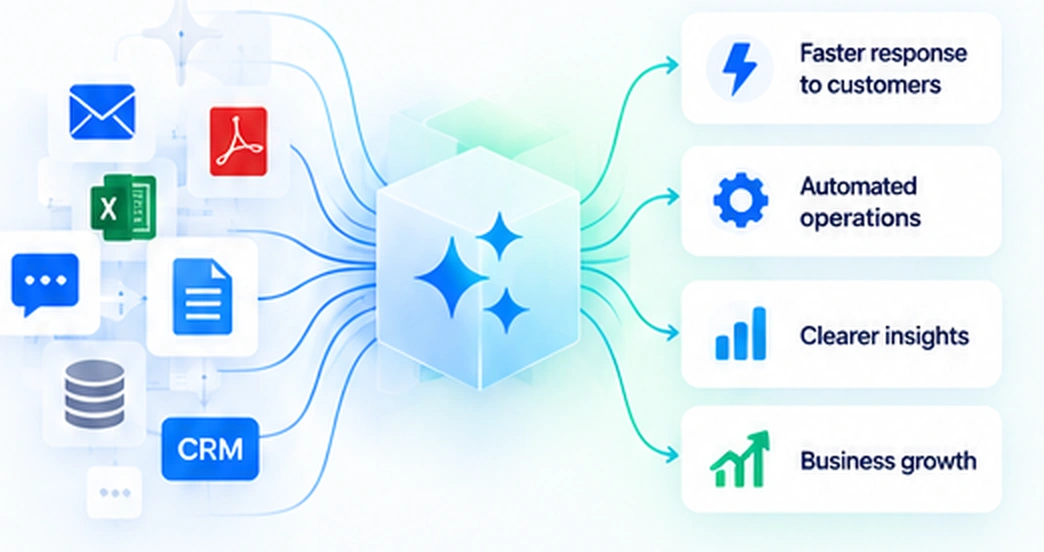
What if the business could grow without the machinery around it growing at the same rate?
Start with three business questions
“AI-first” can sound like a technology strategy. It is more useful to treat it as a business question. Before deciding what technology to use, look at the operation through three simple lenses.
These questions shift the conversation away from “Where can we put AI?” and toward something more useful: where does the way we work today create unnecessary cost, delay or limits on growth?
Something important has changed
Traditional software has always been good at following clearly defined instructions. If a customer selected option A, a system could trigger action B. If a number crossed a threshold, an alert could be sent.
But much of everyday business work is not that tidy. Customers write emails in their own words. Suppliers send PDFs. Employees interpret requests, copy information between systems, summarise updates and decide what needs attention next.
This is where AI changes what is possible.
You do not need to understand AI models to understand the opportunity. AI can increasingly work with the kind of information people handle every day. It can interpret an enquiry, extract information from a document, summarise a case, prepare a response, compare information or identify what may need to happen next.
That does not mean handing the business over to AI. It means that some work which previously needed a person simply because a computer could not understand it can now be redesigned.
Think beyond the chatbot
For many people, their first experience of AI was a chat window: ask a question and receive an answer. Useful, but that is only a small part of the business opportunity.
Imagine a customer emails asking for a quotation and attaches a specification. AI can understand the email and document. Your existing systems can provide customer, product and pricing information. Predictable actions can happen automatically. A person can review, approve or step in wherever judgement is actually required.
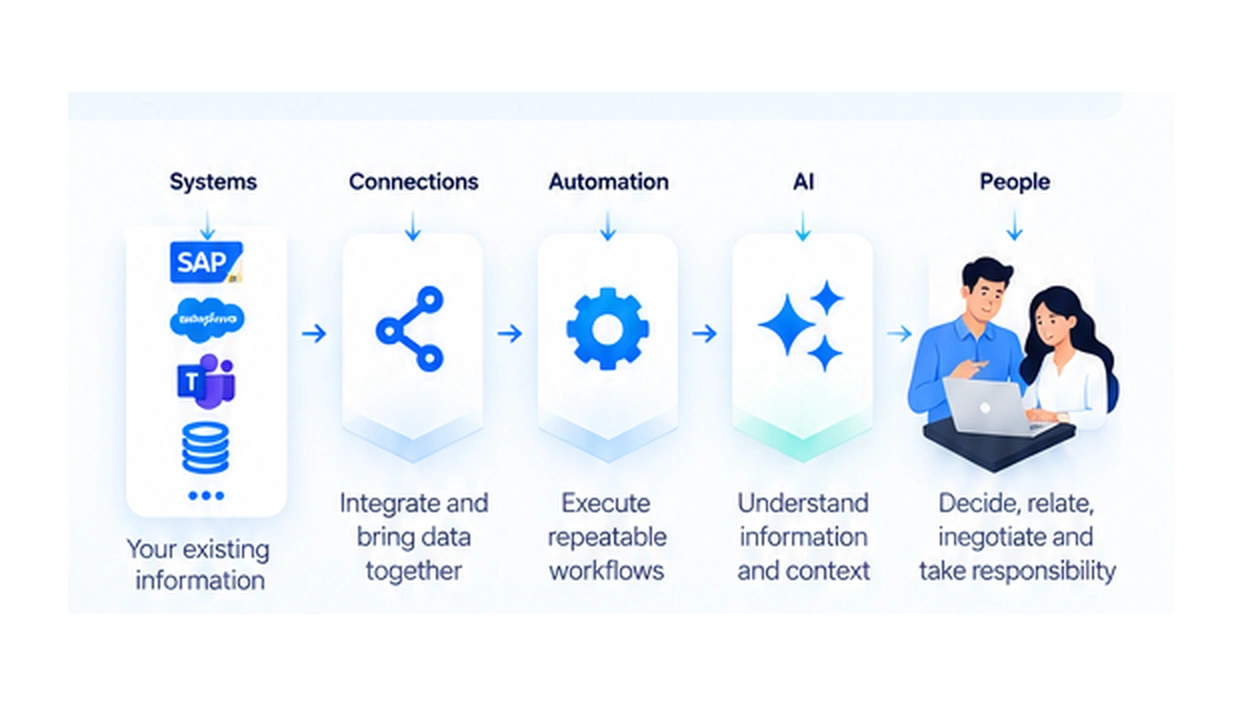
- Systems
- store what the business knows
- Connections
- bring the right information together
- Automation
- executes predictable steps
- AI
- understands information and context
- People
- decide, relate, negotiate and take responsibility
AI is not the whole solution. It is a new capability inside the business. The real opportunity appears when it works with the systems, processes and people you already have.
Now imagine the business starts growing
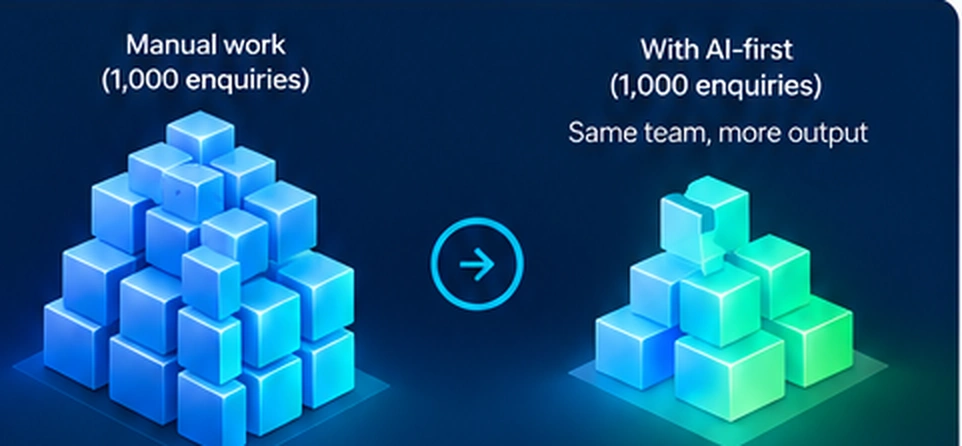
Suppose your team handles 500 customer enquiries every month. Business is going well and that becomes 1,000.
The instinctive response may be: we need another person.
Before you hire, look at what that additional person would actually spend time doing: opening enquiries, understanding what customers want, checking existing information, entering details into a CRM, routing requests, preparing responses, updating records and remembering to follow up.
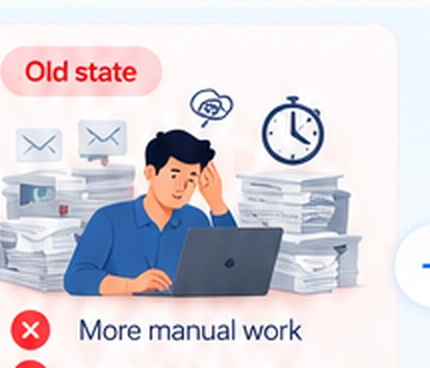
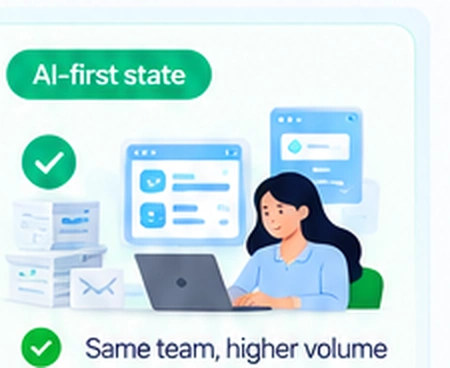
AI can understand the initial enquiry. Connections between your systems can retrieve the information required. Automation can update records and prepare the next action. The salesperson can concentrate on the parts that genuinely need a salesperson: the relationship, the exception, the negotiation and the close.
You haven't removed the salesperson. You've removed much of the administration surrounding the salesperson.
The question is not “Can AI replace this employee?” A more useful question is: “As the business grows, which additional work actually requires another person?”
That changes the economics of growth
Consider a repetitive process that happens 2,000 times per month. At 15 minutes of employee time each, that is 500 hours of work every month. If redesigning the process reduces human involvement to five minutes, the same volume requires roughly 167 hours.
333 hours
of capacity released every month.
At an illustrative fully loaded labour cost of AED 60 per hour, that represents about AED 20,000 per month—or AED 240,000 per year—of capacity value.
That is not automatically cash in the bank. The value might appear as an avoided future hire, more customers handled by the existing team, less overtime, faster response times or employees spending more time on work that creates revenue and customer value.
Research from the OECD supports this broader picture. Among SMEs in its survey already using generative AI, 65% reported improved employee performance and 45% reported saving money.
Source: OECD, Generative AI and the SME Workforce (2025).
The opportunity is especially relevant for growing SMEs
For a growing business, the challenge is often not a lack of software. It is that information and work are spread across email, documents, spreadsheets, finance systems, CRM platforms and the knowledge held by employees.
Research commissioned by du in collaboration with Huawei, covering 648 SMEs in the UAE, reported that only 8% had reached an advanced level of digital maturity. The study also identified integration with existing systems as one of the barriers to further digitalisation.
That matters because becoming AI-first does not require replacing everything. In many cases, the more practical opportunity is to connect what already exists, automate predictable work and use AI where understanding or interpretation was previously the missing capability.
Source: du and Huawei, UAE SME digital transformation research.
Better technology does not automatically mean fewer people
One reason AI conversations become uncomfortable is that productivity is often framed purely as headcount reduction. That is too narrow.
The same OECD research found that, among SMEs using generative AI, 83% reported no change in their overall need for staff. The more immediate effect for many businesses is therefore not necessarily replacing people, but changing where their time goes.
People can spend less time transferring information, preparing routine updates or performing repetitive checks—and more time dealing with customers, exceptions, judgement, relationships and growth.
Source: OECD, Generative AI and the SME Workforce (2025).
Speed can matter as much as cost
A customer enquiry answered in five minutes competes differently from one answered tomorrow. A quotation prepared while a customer is ready to buy is different from one arriving after they have spoken to three competitors. An exception identified immediately is different from one discovered at the end of the week.
So the value of redesigning work should not be measured only in hours saved. Look at response time, throughput, customer experience, decision speed and capacity. Sometimes doing something dramatically faster is worth more than doing it slightly cheaper.
You do not need to transform everything
This is where “AI-first” can sound more intimidating than it needs to be. It does not mean rebuilding the company, replacing every system or putting AI into every process.
Start with one process. Choose something repetitive, time-consuming and increasingly painful as the business grows: enquiries, quotations, invoices, orders, approvals, support, reporting or follow-ups.
- What happens from beginning to end?
- Which steps genuinely require a person's judgement?
- Where are people copying or moving information?
- Where are people reading information simply to understand what to do next?
- Which predictable actions could happen automatically?
- What breaks if the volume doubles?
Some steps will still need people. Some can already be automated. And some that could not realistically be automated a few years ago can now be redesigned because AI can understand the information involved.
That is the journey: not from people to AI, but from an old process to a better process.

The next time growth creates more work
The instinctive answer may still be to add another person—and sometimes that will be exactly the right decision.
But before making it the default, ask one question:
If we were designing this process today, knowing what technology can now do, would we still design it the same way?
Sometimes the answer will be yes. Increasingly, there will be another way to structure at least part of the work.
That is what being AI-first really means. Not putting AI everywhere. Designing the business you would build if you were starting it today.
Scale the business. Not the complexity.
Start with the work that becomes harder every time your business grows. Understand the process first. Then decide where people, automation, existing systems and AI each belong.
Illustrative calculations are not guarantees of savings or performance.
Enjoyed this perspective?
Follow YANC on LinkedIn for new insights on business, technology and scale.